AMIRI Jeans: Every Cut and Treatment Explained
A Los Angeles house, AMIRI has denim as the category the rest of the range grew out of. Mike Amiri set the label up in his hometown, with two citable dates: the brand’s about page prints 2014 while the earliest contemporaneous press release, from December 2014, gives 2013 and calls the launch a partnership with the retailer Maxfield. The debut was an exclusive capsule at that store either way, and the pieces carrying it were hand-distressed and visibly repaired jeans. Repair remains the operative verb, since the denim is abraded on purpose, then rebuilt with contrast material instead of patched invisibly. Price and naming both follow from that single idea, and the naming looks more complicated from outside than it really is. The person typing amiri jeans into a search box is generally trying to see which names are shapes and which are surfaces. This walkthrough holds the two apart and then goes fit by fit.
Two different lists: fits, and treatments
The names in this line divide into two groups with different behaviour. Fits make up the first group, since MX1, MX2, Stack, Thrasher, Shotgun, Carpenter, MA Fit and Baggy are cuts and constructions. Treatments make up the second group, because Bandana, Crystal, Stud, Eagle, Aloha and Monogram are motifs worked over those cuts. Because a treatment travels across several fits within one season, an MX1 Bandana and a Crystal Thrasher can hang on the same rail. Coverage of this brand errs most often by treating a Bandana jean as a peer of the MX1. Keep the two lists apart and the assortment comes down to a handful of shapes wearing a rotating set of finishes.
MX1
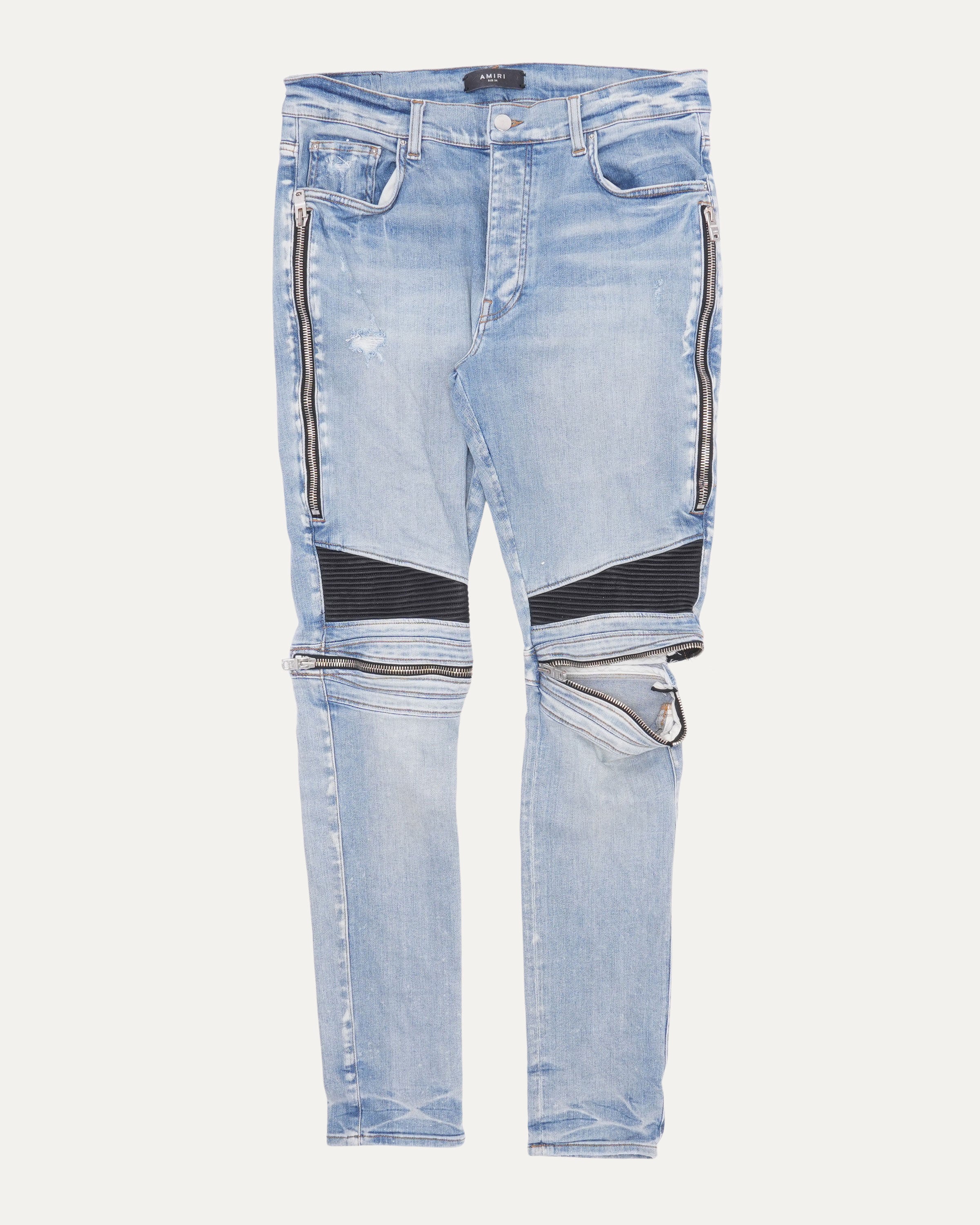
MX1 is the signature model. In official copy it is a skinny-fit jean in Italian stretch denim with classic five-pocket styling, hand-distressed and repaired using pleated leather. The contrast is listed as ovine leather, and the panels sit inside the abraded zones at knee and thigh instead of being laid on top as decoration. At 92 percent cotton, 6 percent elastomultiester and 2 percent elastane, it sits within the Core Collection amirishoes.org and is made in the USA. An observed market price of $1,090 puts it at the top of the standard denim band. If you try one pair only, this is the reference the rest of the category gets measured against.
Stack
At an observed $750, Stack is the opening price to core denim. In official copy the Stack jean is Italian stretch denim, skinny fit, five-pocket, and it has an intentional overdye treatment. What defines it is length, not distressing: the inseam is engineered long, so the leg concertinas at the ankle over a boot or over amiri sneakers. Pooling of that kind is the design rather than a fault in the tailoring, so changing size because of it is a mistake. The composition matches the MX1, and this jean too is made in the USA. It is the quietest piece in the range, which makes it a reliable first pair.
Thrasher
Thrasher is the purest expression of hand-distressing. The cut is skinny and mid-rise in hand-worked Italian stretch denim, and retailer copy says the abrasion mimics what Mike Amiri applied to jeans in the nineties. What separates it from the MX1 is the absence of a structured leather panel, since the repair happens through abrasion and rebuilt fabric rather than an inserted material. Distribution is the broadest of any cut here as well, with the jean turning up at department stores and specialists at the same time. Variants seen in market include Crystal Thrasher, Eagle Thrasher, Leather Thrasher and Hollywood Thrasher. Go for it if you want the wear and none of the hardware.
Shotgun
Shotgun is the most aggressive of the current shapes. House framing sets the frayed holes down to a continued exploration of material distortion, achieved through a specialised battle-worn treatment. What that means in practice is shot-through openings, sanded at the edges, set into faded Italian denim, so the damage reads as impact and not as fade. It is made in straight-leg and skinny versions, and some carry the extended inseam that lets the leg stack. Crystal Shotgun exists too, putting embellishment right up against destruction on one garment. Reach for this pair when the treatment rather than the silhouette is the point.
MX2 and MX3
MX2 is unambiguously a real name, but status and definition alike need care. The brand has hosted MX2 collection pages, yet those returned no live products when checked in 2026, while it remains plentiful at off-price retail and on resale. So it registers as archive-leaning instead of a current headline cut. Sources also disagree about what defines it, some describing bandana or contrast denim inserts in place of leather, with retailer copy leaning toward ribbed leather patches, zippered knee vents and outseam zips. The honest line is that MX2 is the zip-detailed sibling of the MX1 and that circulating descriptions do not agree. MX3 appears on the brand’s site only as a women’s Baggy MX3 at an observed $990, a no-waistband motocross-inspired hybrid, so that repeated idea of a numbered men’s ladder has nothing behind it.
Carpenter, Baggy and MA Fit
This group is for anyone who dislikes a narrow leg, because not everything here is skinny. Carpenter, Faded Carpenter and Carpenter Repaired Baggy add workwear detailing along with a considerably more generous line. Volume goes further again with Washed Baggy and Baggy Cargo, and the MA Fit jean sits between the poles as a modern regular cut. Repaired Boot Cut, Monogram Straight Leg, Track Jean and the Patchwork and Art Patch constructions are further real names in the same territory. As a group they hold the same broad band as the skinny cuts, and the most heavily reconstructed pairs go above it. These roomier shapes have quietly become the more forgiving half of the category.
The treatments that travel across the fits
Most of the seasonal work happens in the treatments, which is why one shape can reappear looking unrelated to itself. Bandana shows it most clearly: the paisley panel sits in exactly the structural position the leather holds on an MX1. It is therefore a substitution, not an ornament, which is genuinely different from a print. Crystal is an embellishment applied to existing styles, and crystal pieces land at the top of the price band wherever they appear. The same behaviour comes from Stud, Eagle, Aloha and Monogram, which appear on an amiri hoodie or a pair of shorts within one season. Read a product name from the front and it usually parses as treatment first, then fit.
- MX1 Bandana Jacquard and MX1 International, where pleated bandana print replaces the leather
- Bandana Repair Straight Jean, which is a full product name in its own right
- Crystal Thrasher and Crystal Shotgun
- Stud MX1 and Aloha MX1
- MX2 Bandana and MX2 Plaid Patch, mostly found off-price these days
The observed prices, fit by fit
What follows are observed market listings rather than an official price list, and the numbers change. Two channels behave differently enough to separate: full-price retail from the brand itself, and large multi-brand stockists whose listings include in-season markdowns. Anyone looking at amiri men in both channels will find the same jean at two very different numbers within one season. Because discounting is structural, with reductions of roughly 40 to 70 percent visible in-season at authorised retailers and off-price arms, the idea that the brand never marks down is incorrect. That sale floor also caps what buyers pay on the secondary market, where standard MX1 pairs change hands well below full retail. The table is a snapshot, so re-check before acting on a single number.
| Fit | Defining feature | Where it lands |
|---|---|---|
| MX1 | Pleated ovine leather set into distressed zones | The signature, observed $1,090 |
| Stack | Engineered long inseam that stacks at the ankle | The entry point, observed $750 |
| Thrasher | Nothing but hand-distressing, without a leather panel | Core band, broad distribution |
| Shotgun | Frayed openings shot through, edges sanded | Core band, straight and skinny |
| MX2 | Zip detailing at knee and outseam, though sources conflict | Archive-leaning rather than current |
| Carpenter, Baggy, MA Fit | Workwear detailing and modern roomy cuts | Core through to the upper band |
| Baggy MX3 | A motocross-inspired hybrid with no waistband | Womenswear only, observed $990 |
Sizing, care and country of origin
Fit guidance comes from buyers rather than from published sources, since complete garment measurements are not released for every style. The core skinny cuts run deliberately narrow, and waist sizing is broadly true to the labelled inch, so the leg is where the trouble lies. Buyers with muscular thighs or calves commonly say they take a bigger size one or two sizes to keep a slim line. Legs that look long on Stack and Shotgun are the stacking inseam doing its job, and no size change should follow. Ordinary denim is easier to look after, because core pairs here warn about intentional shading variation and dye transfer and are to be spot-cleaned only, with no washing, bleaching, tumble drying or ironing. Origin varies by style: MX1 and Stack are made in the USA, but the blanket claim that all amiri clothing comes out of Los Angeles does not stand.